
The Unsung Steward Within
Before there was a product for every problem, people patched, sharpened, soaked, stitched and improvised. A torn coat became a quilt. A dull blade met a stone. Hard beans went into water overnight so they'd be soft by morning. Nobody called it innovation. It was just Tuesday.
I've come to believe that was Creative Intelligence in its oldest form: the ability to look at what you have, see what it could become, and make it so. It didn't arrive with the technology. It's been in our hands, and our families, for a very long time. And the people who practiced it best were rarely the ones being thanked.
The work nobody applauds
Look around your own life and business and you'll find the same quiet pattern. Someone keeps the family held together. Someone catches the error before it reaches the customer. Someone turns a messy quarter into a workable plan at eleven at night, and the credit goes to whoever presents it.
Maybe that someone is you. If so, you know the particular fatigue of being relied on and not seen. After a while, you may start believing the work doesn't count, because no one has said it does.
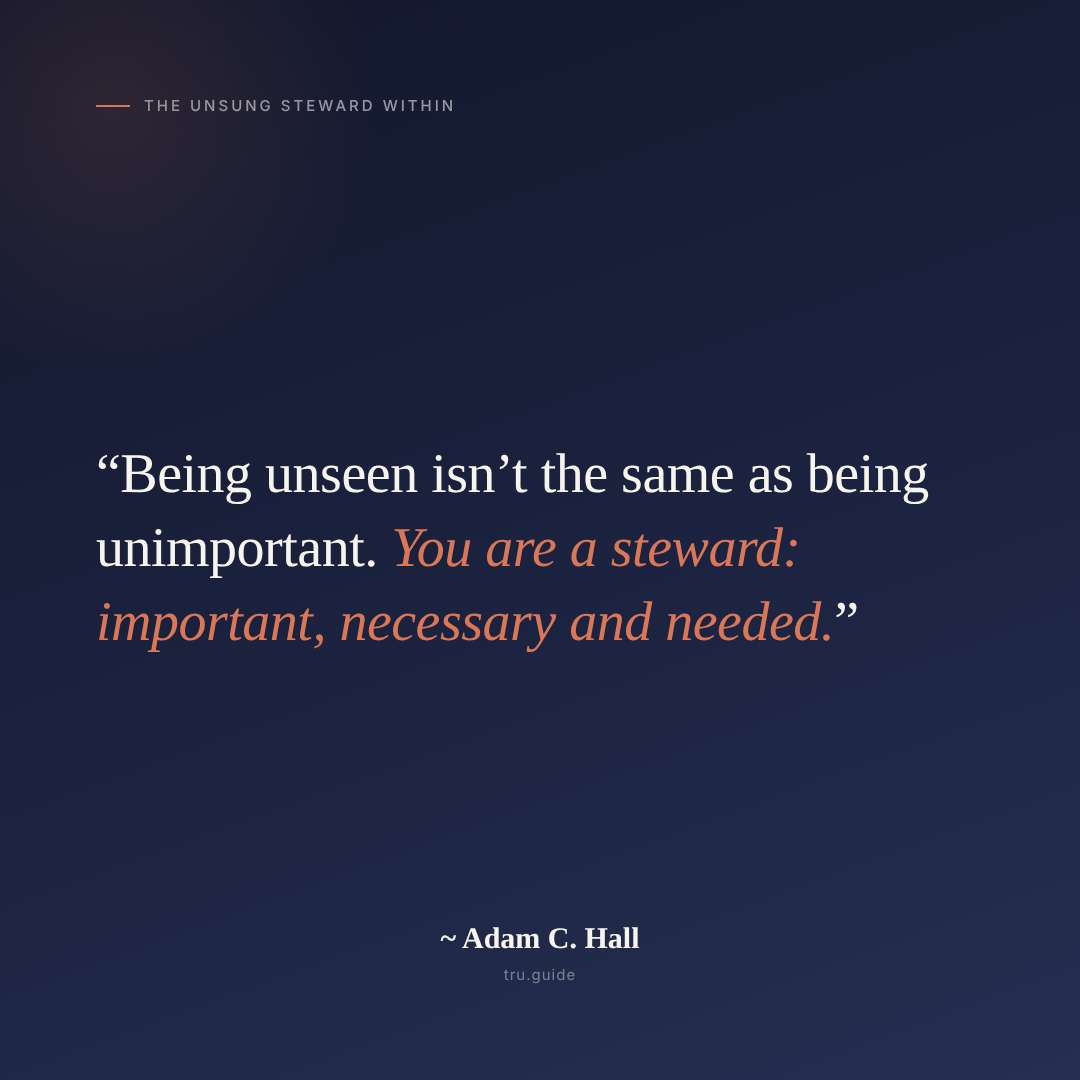
I'd like to offer a different reading. Being unseen isn't the same as being unimportant. You are a steward: important, necessary and needed. A steward tends what's been entrusted to them, whether that's a family, a team, a craft or a company. And stewards, by nature, work in the background.
A woman, a seedling and a hummingbird
In 1977, in Kenya, Wangari Maathai began planting trees. Her Green Belt Movement taught rural women to grow seedlings and plant them to protect water supplies and provide firewood, and the women were paid a few shillings for each seedling still alive after three months. It looked small. It was not welcomed by everyone. The president of the day called her "mad," and she was pushed from government offices and publicly attacked when she stood against a plan to build a 60-storey tower in a Nairobi park.
She kept planting. In 2004, she received the Nobel Peace Prize, the first African woman to do so, recognized for sustainable development, democracy and peace. She did it one seedling at a time.
Maathai loved to tell a story about a hummingbird. A great forest burns, and the animals huddle at the river's edge, certain nothing can be done. Only the hummingbird flies back and forth, carrying single drops of water to the flames. When the others tell her it's pointless, she answers that she is doing what she can.
That's the unsung steward, in one small bird. She doesn't wait for permission, scale or applause. She does the work in front of her, in the middle of a crisis that would have scared most of us into watching from the bank.
(Those who know my Sedona mornings will recognize the hummingbird. I like to think she was making a point.)
My first unsung steward
The most important teacher of this lesson in my life was my mother.
I don't mean it in the greeting-card way. For a long time, I carried feelings that many of us who build things share: that I'd been left, that I wasn't enough, that whatever I accomplished would have to make up for something. I spent years trying to out-build that ache. It never held.
What I understand now is that my mother was one of the great teachers of my life, and that teaching came as a demand. The path she set in front of me required me to feel what I'd been outrunning and to unlearn the pain, one layer at a time. It wasn't gentle. It was the kind of lesson that only works because it can't be skipped.
Years later, she told me something that rearranged the whole story. "I left you at times," she said, "to give you the room to fall down and get up on your own accord."
I've thought about that sentence more than almost anything anyone has said to me. What I experienced as being left, she experienced as making room. The very thing I'd built a lifetime of proving around turned out to be her quiet way of trusting me to stand. That's what an unsung steward does. She tends, she steps back, and she lets the growing happen, usually without credit, and sometimes at the cost of being misunderstood by the very person she's serving.
She never got a plaque for it, and neither did I. But I can tell you exactly where the steward in me was forged. And I suspect many of you can name your own, a person or a season whose demand on you, at the time, felt like a wound, and later turned out to be the work of an unsung steward.
(If you're curious whether this ever gets easier: yes. Not smoother, but more spacious. Like a room with a window finally opened.)
Creative intelligence is the way forward
Here is where the old patching and the new era meet.
AI can now do what once took teams, and the tools are the same for everyone. The edge, as I wrote not long ago, is the creative act itself: the willingness to generate what doesn't yet exist, commit it to form, and begin again when the form fails. That takes resilience, and it takes the oscillation between possibility and structure. It is the same capacity our grandmothers used with a needle and an empty cupboard.
That's what we carry into 2027. Not more tools. The steward within, finally seen, and finally leading.
Here are three simple moves.
1. Name the patchwork. Write down what you quietly hold together: the things no one assigned you, the failures you prevented, the people you steadied. Seeing your own work is the first act of stewardship.
2. Let it be seen. Not for ego. For the person who needs exactly what you know and can't find it. The unseen work stays useless to the one who is looking for it. At TruGuide, helping creators and stewards be found is why we exist.
3. Rise from it. Lead from what you actually do, not from the title you were given. The hummingbird didn't hold a position. She held a purpose.
The blossom beyond the chaos
Every era of upheaval looks like a collapse from inside it. Fires, markets, algorithms, noise. And every one has also been a ground for something to grow.
The coming year will keep asking us to move through uncertainty. I don't think the answer is to be louder. I think it's to be more rooted: to trust the steward within and let the work, finally, be seen.
The blossom isn't in spite of the chaos. It comes through it.
Who has been the unsung steward in your life, and where are you being called to become one?
~ Adam
Sources: Nobel Peace Prize 2004 coverage and Wangari Maathai's death, NPR (KUNC), September 26, 2011. "The Hummingbird Revolution," World Mission magazine.
Adam C Hall is a published Author, Inspirational Speaker, and CEO/Co-Founder of TruGuide Inc.
Signup to receive weekly blog updates directly in your inbox and an ebook on Abundance as a free gift!
We respect your privacy and will never sell your info to third parties.