
The Secret to Navigating the Future
Everyone is racing to master the "what" of the coming era — AI-native companies, agentic systems, businesses reimagined top to bottom. Fewer people are asking the harder question: who has to do the imagining in the first place?
That's the secret. Not the tools. The mind that directs them. Specifically: Creative Intelligence.
The Landscape Is Already Shifting
This isn't speculative — it's happening in the numbers right now. Sixty percent of new business owners used AI to launch their business in 2025, double the rate from just two years earlier, and three-quarters of them used it specifically to develop the original business idea. Industry-wide AI adoption jumped from 21% to 44% over that same window. AI is lowering the minimum efficient scale of a business — the revenue point at which hiring a specialist finally pays off — allowing a single founder to now pool functions that once required a full team. U.S. business applications hit roughly 524,000 in May 2026 alone.
The floodgates are open. Starting something has never been more accessible.
The Challenge Hiding Inside the Opportunity
Here's the catch: when the tools are the same for everyone, the tools stop being the edge. AI has already captured roughly half of global venture funding and is compressing the time it takes any idea to reach revenue. Speed and access — the things that used to separate winners from the field — are now table stakes.
Which means the bottleneck has moved upstream. The question is no longer "can we build it fast?" It's: do we know what's worth building, and why? That's not a prompting problem. It's a human one. And it's also the opportunity: lower overhead means more people than ever can act on an original idea without needing capital or headcount first. The barrier to starting has collapsed. The barrier to originating has become the entire game.
Two Hemispheres, One Edge
This is where most leadership conversations stop short. They frame it as a left-brain problem: pick the right AI stack, optimize the workflow, execute faster. But logic and execution are exactly what's being automated. The left brain — sequencing, analysis, systems — is no longer the differentiator. The right brain — pattern-breaking, meaning-making, original synthesis — is where Creative Intelligence actually lives.
But here's the deeper truth: the edge isn't found by picking a side. It's found in the movement between them.
Quantum physics offers a useful way to hold this. At the subatomic level, a particle doesn't have one fixed location — it exists as a field of possibility, a superposition of states, until observation collapses it into a single outcome. Your creative capacity works the same way. Held only in the analytical, sequential left brain, an idea collapses too early — locked into whatever's already known, already proven, already safe. Held only in the open, associative right brain, it never collapses at all — it stays a beautiful field of possibility that never becomes a product, a decision, or a company.
The unlock isn't choosing a hemisphere. It's oscillation — moving fluidly between the expansive, non-linear right brain that generates genuinely new possibility, and the precise, structured left brain that collapses that possibility into something real and executable. Creative Intelligence lives in that movement, not in either state alone. Leaders who can only execute will outproduce anyone in an AI-saturated market. Leaders who can only imagine will produce nothing at all. The edge belongs to whoever can move between the two states on command — generate the field, then collapse it into form, then expand again.
Resilience Is the Price of Admission
There's a cost to living in that oscillation, and it has to be named honestly: you have to get comfortable with failure.
Every real act of creation starts in uncertainty — a field of possibility with no guaranteed outcome. Collapsing that field into something real means committing to a form before you know for certain it's the right one. Most of those first collapses won't be it. That's not a flaw in the process — it is the process. Creative Intelligence doesn't produce a shortcut around failure; it produces the resilience to treat failure as data, collapse again, and keep moving.
This is precisely why Creative Intelligence compounds as a leadership advantage in the AI era. Machines can iterate infinitely without cost to identity. Humans can't — every failed attempt lands somewhere personal. The leaders who thrive won't be the ones who fail less. They'll be the ones who've built the internal resilience to stay in motion between possibility and form, attempt after attempt, without collapsing themselves along with the idea that didn't work.
The Creative Act Is the Final Act
Once every company has access to the same intelligence tools, the last differentiator left standing is the creative act itself — the willingness to generate what doesn't yet exist, commit it to form, and do it again when the form fails. That's not a phase of business that gets automated away. It's the source from which everything else flows.
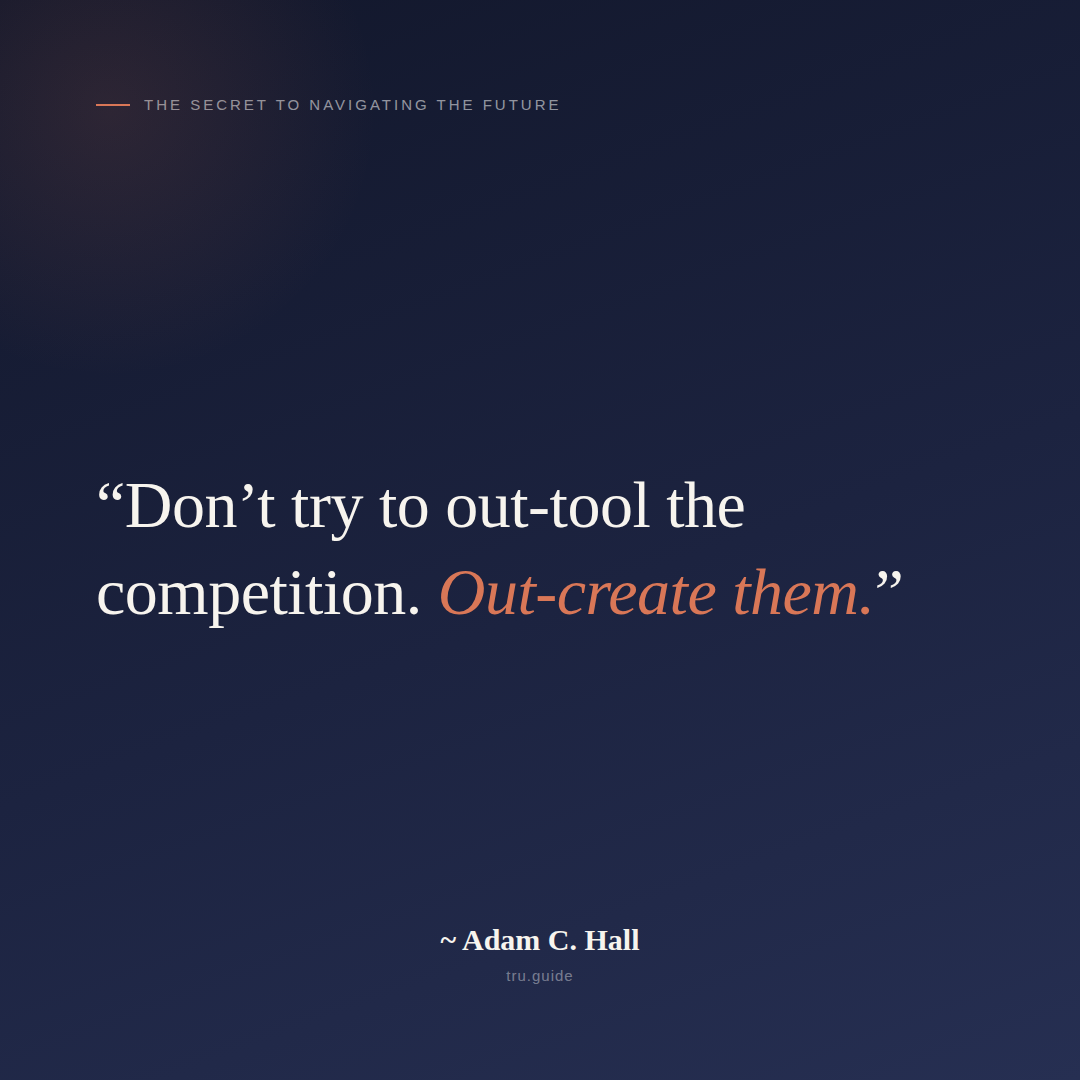
Big company or one-person business, the mandate is identical: don't try to out-tool the competition. Out-create them. And build the resilience to keep creating when the first version doesn't hold.
Where in your work are you still waiting for certainty before you're willing to collapse the possibility into form?
~ Adam
This article originally appeared on the TruGuide blog.
Adam C Hall is a published Author, Inspirational Speaker, and CEO/Co-Founder of TruGuide Inc.
Signup to receive weekly blog updates directly in your inbox and an ebook on Abundance as a free gift!
We respect your privacy and will never sell your info to third parties.